Atracciones


Musée Dar El Bacha, Rue Fatima Zahra, Marrakesh, Morocco
MUSEE DAR EL BACHA
Dar El Bacha, also known as the “Palace of the Pasha,” is a stunning example of Moroccan architecture and a symbol of Marrakech’s rich history. Built in 1910, this magnificent palace was the residence of Thami El Glaoui, the powerful Pasha of Marrakech, who played a significant role in Moroccan history during the early 20th century.
The architecture of Dar El Bacha is a testament to the grandeur of Moroccan craftsmanship. The palace features a harmonious blend of traditional Moroccan elements, including intricate zellige tilework, carved cedarwood ceilings, and beautifully landscaped gardens. Each corner of the palace tells a story of Morocco's rich cultural heritage, from the ornate courtyards to the grand reception halls.
The Museum of Confluences offers visitors a unique opportunity to explore the rich tapestry of Moroccan culture. The exhibitions showcase a wide range of artifacts, from traditional Moroccan art to contemporary works, reflecting the country’s diverse heritage. The museum also hosts cultural events and temporary exhibitions, making Dar El Bacha a living testament to Morocco’s ongoing cultural dialogue.

Jardin Majorelle, Rue Yves Saint Laurent, Marrakesh, Morocco
JARDIN DE MAJORELLE
The Majorelle Garden (in Berber: ⵓⵔⵜⵉ ⵎⴰⵊⵓⵔⵉⵍ; in Arabic: حديقة ماجوريل) is a tourist botanical garden with around 300 species covering nearly 1 hectare (10,000 m²), an Art Deco villa listed as a Maisons des Illustres since 2011, and a museum of Berber history in Marrakesh, Morocco.
The garden is named after its founder, French painter Jacques Majorelle (1886-1962), who created it in 1931, drawing inspiration from oases, Islamic gardens, and Spanish-Moorish gardens. Purchased by Yves Saint Laurent and Pierre Bergé in 1980, it now belongs to the Jardin Majorelle Foundation — which also includes the Yves Saint Laurent Museum — and is one of Morocco's top tourist attractions, with nearly 600,000 visitors annually.
In 2022, according to a ranking by the English-language website HouseFresh, which aggregated the opinions of tens of thousands of tourists, the Majorelle Garden was named the second most beautiful garden in the world, behind Gardens by the Bay in Singapore and ahead of the Luxembourg Gardens in Paris.

Bacha Coffee Marrakech, Dar el Bacha, Route Sidi Abdelaziz, Marrakesh, Morocco
BACHA COFFEE
The story of Bacha Coffee begins in the medina of Marrakech, Morocco. Built in 1910, the spectacular Dar el Bacha palace, which means “house of the Pasha”, united the greatest cultural and political minds of the century over glittering pots of “coffee of Arabia” or Arabica, as it is known today. Closed for 60 years, Bacha Coffee has reopened to continue the tradition offering fine 100% Arabica coffees from around the world.


Le Jardin Secret, Rue Mouassine, Marrakesh, Morocco
JARDIN SECRET
The Secret Garden is a true floral and architectural masterpiece. An iconic place to visit during a trip to Morocco with friends or family, you can explore a complex comprising two gardens and numerous buildings—including one of the tallest towers in the entire Medina—as well as relax between visits with a cup of tea or a stroll through the souvenir shops. Accessible to people with reduced mobility, you can visit the Secret Garden of Marrakech every day from 9:30 a.m. to 7:30 p.m. The café and shops are also open during these hours.
Although the inaugural palace was built over 400 years ago, it eventually fell into disrepair and it wasn't until the early 2000s that it was restored, once again becoming a must-see attraction in the center of Marrakech. To achieve this, numerous architects and craftsmen worked to restore the property to its former glory, creating two magnificent gardens.
The Exotic Garden features many plants from around the world, including Madagascar and South America, while the Islamic Garden is home to several species of olive and orange trees, as well as fragrant lavender for your enjoyment. Originally created to irrigate the various plots of land, the Islamic garden is a true metaphor for paradise, as described in the Koran. It is a sacred place, with very strict geometric rules, where Muslim order radically prevails over the disorder of wild nature. You can also visit the Secret Garden tower, which offers a simply spectacular view of the Medina and its surroundings. It is as tall as some of the minarets in Marrakech.
In addition to the gardens we have just mentioned, you can enjoy delicious flavours by choosing a restaurant overlooking the entire garden, or stroll around and discover the many shops. These shops sell souvenirs and paintings and generally offer a wide range of gifts for your loved ones. You can also discover reproductions of original photographs, made exclusively for the establishment. Finally, this haven of peace is home to a café where you can enjoy a welcome break during your visit to the Secret Garden. You will have the opportunity to enjoy the calm and serenity of the riad, savouring a delicious Moroccan mint tea, or discovering homemade cakes or smoothies made with fresh fruit and vegetables. In short, in addition to the beauty of the gardens, this place rich in history offers many other things to see and discover.


Place Des Epices, Marrakesh, Morocco
PLACE DES EPICES
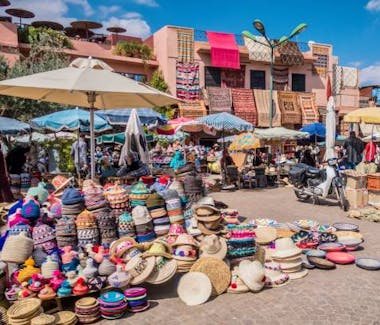
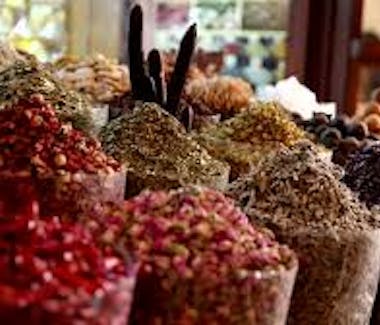
Nestled in the heart of the medina, the Place des Épices is a must-see for all lovers of Moroccan culture, gastronomy and crafts.
A true sensory delight, this place captivates visitors with its stalls overflowing with colours and scents, where spices, aromatic herbs, teas and local products intermingle to offer an authentic and captivating experience.
Strolling through the Place des Épices means immersing yourself in the lively and warm atmosphere of Marrakech: the welcoming merchants, the intoxicating smells and the hustle and bustle of the narrow streets create a unique atmosphere, typical of the medina.
Visitors can not only discover an incredible variety of products, but also observe the craftsmanship of artisans who perpetuate centuries-old traditions, from spice blends to local culinary preparations.
The square is also surrounded by cafés, small stalls and craft shops, offering a perfect blend of culture, gastronomy and traditional trade.
Photographers and curious visitors will find a thousand opportunities to capture the authenticity and beauty of the place, while food lovers can leave with fragrant and colourful souvenirs of their visit.
Whether you are passionate about cooking, curious about local traditions or simply eager to enjoy a unique experience, the Place des Épices in Marrakech immerses you in the heart of Moroccan authenticity, with its colours, scents and lively atmosphere.

Souk Semmarine, Marrakesh, Morocco
SOUK SEMMARINE
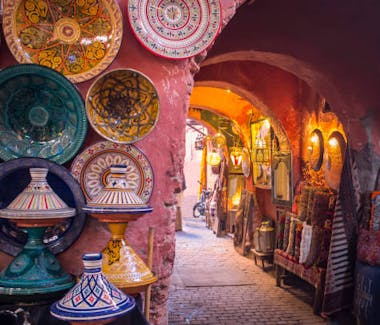
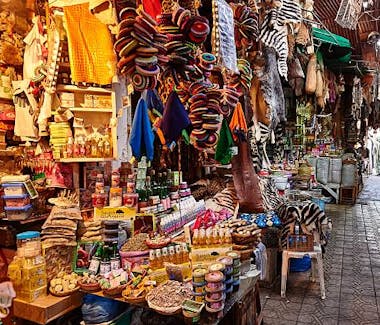
The souks of Marrakech are a veritable Aladdin's cave. Slippers, bags, jewellery, tableware, pottery... the craftsmanship of Moroccan artisans is rich and sophisticated. Between counterfeits and haggling, it's easy to get lost. Here is our non-exhaustive list of shops worth visiting around the Marrakchi souks.
There are 18 souks in the medina of Marrakech. Among them, we recommend:
Souk Dhabia: Calling all lovers of jewellery, bracelets, rings and necklaces, this souk is dedicated to all things jewellery.
Souk Smata: Here you will find thousands of babouches (traditional slippers) in every colour, with or without embellishments, displayed on large sections of wall.
Souk Attarine: A souk dedicated to the sale of spices and kitchen utensils, which we recommend for cooking enthusiasts.
Souk Cherratine: A leather souk where you can find bags, belts, pouffes and other leather accessories.
Souk Semmarine: Here you can buy mainly Moroccan pastries and fabrics, but that's not all. This souk is one of the most interesting because it combines the expertise of the Berber tribes of the south and the Arabs of the cities
Our tips for visiting the souks
The first tip we would give you is not to plan your route and just let yourself be carried away by the souks of Marrakech. You can wander around, letting your senses guide you through the scents of spices and leather, or through the colours, and discover all the surprises they hold.
Also, keep an eye on your personal belongings and avoid asking anyone on the street for directions. Some people will ask for payment in return for helping you. We recommend asking the artisan vendors in the souks for directions. Take advantage of your strolls through the medina to discover Marrakech's most charming restaurants, of which there are many.


Medersa Ben Youssef, Rue Assouel, Marrakesh, Morocco
MEDERSA BEN YOUSSEF
The Ben Youssef Madrasa is one of the country’s most important sights from an art-historical perspective. But even those who are not interested in art or history should pay a visit to the Madrasa, as the inner courtyard with the water basin and the lavishly decorated building are definitely a feast for the eyes and leave lasting impressions.
You should allow at least one hour to visit the Madrasa, as it would be a shame to just look at the ornate decorations in passing. If you want to see everything in peace and quiet, you should be ready in the morning at opening time if possible.
The outstanding feature of the Koranic school is the spacious inner courtyard with the water basin and the surrounding colonnade, decorated with traditional craftsmanship.
If you are unsure whether you should visit the Bahia Palace or the Madrasa, I would recommend the Madrasa. From an art historical point of view, the medersa is the more beautiful example of Islamic architecture and the visit is also quicker, as the Madrasa is smaller but has the more beautiful overall composition to offer. The Bahia Palace, on the other hand, offers a lushly planted garden that rivals the architecture.
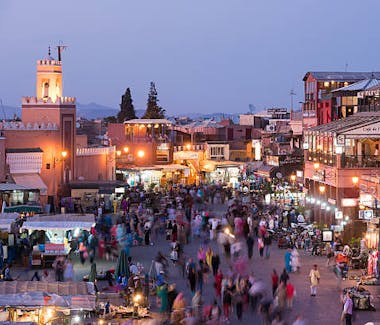

Place Jemaa el fna, Marrakesh, Morocco
PLACE JAMAA EL FNA
Jemaa El-Fna Square, the true centre of public life and driving force behind tourism in Marrakech, has been listed as a UNESCO World Heritage Site since 1985 and on the Representative List of the Intangible Cultural Heritage of Humanity since 2008. Between legends and traditions, you will learn everything there is to know about this iconic place in the Red City.
Founded in 1071, it is the work of the Berber Sanhaja dynasty of the Almoravids. It immediately became a place of justice where sentences were carried out in the public square. It was also active from a military point of view, as army parades and processions took place there.
From the 16th century onwards, its activity evolved. Luis del Marmol Carvajal described it as ‘a cosmopolitan place with a high level of commercial activity’. Over the following centuries, the illustrious square in Marrakech became a venue for live entertainment, with dancers, storytellers and singers. Cafés, hotels and restaurants were also built there in the 20th century.
Today, the square is preserved and has retained its mystique. Morocco owes the authenticity of its agora to its former king, who, in 1921, issued a decree prohibiting any construction that would detract from the image of the square.


Palace of the bahia, Marrakesh, Morocco
PALAIS BAHIA
The Bahia Palace, located south of the medina (the historic centre of the city), is an important monument of Morocco's cultural heritage. Now converted into a museum, it is a must-see during any stay in Marrakech. Its Moorish style and vast size, covering 8 hectares, will leave you speechless.
Let yourself be carried away by the beauty of the place and take home some wonderful memories when you visit the Bahia Palace.
The history of the place
The Bahia Palace means ‘the Palace of the Beautiful’ in English. It was built by a powerful and wealthy vizier: Si Moussa, chamberlain to Sultan Hassan I. It later belonged to his son Ahmed Ben Moussa. The name of the palace refers to his four wives and 24 concubines, to whom it is dedicated. Begun in 1866, the palace took more than a decade to complete, with extensions and alterations mainly orchestrated by the Grand Vizier's son. Most of the work was carried out by the architect Si Mohammed El Mekki with the help of the best craftsmen of the time.
During the French protectorate in 1912, General Lyautey occupied the premises with other officers. He installed fireplaces, a heating system and electricity.
Today, the Bahia Palace is a cultural site, transformed into a museum that is open to visitors. It is also frequently used for exhibitions, as well as concerts, which are usually held in the outdoor courtyard. There are restaurants all around where you can relax.


Minaret de la Koutoubia, Avenue Mohammed V, Marrakesh, Morocco
LA KOUTOUBIA
Nestled in the bustling heart of Marrakech, Koutoubia Mosque stands as a magnificent testament to Moroccan spiritual heritage and architectural grandeur. Known for its striking minaret that towers over the cityscape, this historic mosque is not only a pivotal place of worship but also a symbol of Islamic art and culture in Morocco.
Constructed during the reign of the Almohad Caliph Yaqub al-Mansur in the 12th century, Koutoubia Mosque is a masterpiece of Islamic architecture, renowned for its decorative arches, intricate tile work, and sprawling gardens. It serves not only as a key religious site but also as a beacon of peace and a source of inspiration for architects and historians alike.


Les Tombeaux Saadiens, Rue de La Kasbah, Marrakesh, Morocco
LES TOMBEAUX SAADIENS
Remains of the Saadian dynasty
Close to the Kasbah, this necropolis of the Saadian dynasty (1524-1659) was rediscovered and opened to the public in 1917, after being entrusted to the Fine Arts Department for restoration. These tombs, which date from the end of the 16th century, considered the city's golden age, are the work of Sultan Ahmed el Mansour, known as the Golden, who also built the El Badi Palace. In the 18th century, Sultan Moulay Ismail decided to erase all traces of the previous dynasty and ordered the tombs to be walled up. They were not rediscovered until 1917.
This funerary complex, consisting of a chapel and three burial chambers, is located in the heart of a charming enclosed garden, which contains the tombs of Ahmed the Golden's twenty-four wives and those of a few soldiers and loyal servants. Around sixty graves are scattered throughout these three rooms, which feature minimalist Hispano-Moorish décor with tombs decorated with multicolored zellige tiles and arabesques, vaulted ceilings with stucco stalactites, and Italian marble.
First, in the koubba (dome), we find the remains of Mohammed Ech Cheikh, the founder of the Saadian dynasty. Continuing on, we come to the Mihrab room, which was originally an oratory used as a prayer room, to which the tombs of sultans were added from the 18th century onwards. The latter is divided into three naves by four white marble columns and a magnificent door that leads to the large funeral hall, the Hall of Kings, which serves as the main mausoleum. In this hall with twelve columns decorated with Carrara marble lies the tomb of Sultan Ahmed the Golden in the center of the room, along with those of his family. The tomb is surmounted by a cedar wood dome sprinkled with gold leaf and decorated with poetic epitaphs. Finally, the Hall of Three Niches contains the tombs of the children of the Saadian sultans.